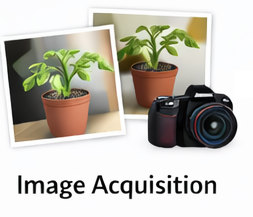
Image Acquisition
A set of source images is collected to capture the plant and scene from multiple viewpoints.
Public project showcase
A 3D reconstruction pipeline for creating digital plant representations for phenotyping and digital twin research.
This project explores how image-based 3D reconstruction can support the development of plant digital twins. Starting from raw images, the pipeline uses masking, structure-from-motion, and 3D Gaussian Splatting to generate interactive 3D models that preserve plant form in a way that is useful for visualization, interpretation, and future quantitative analysis.
Plants are complex three-dimensional organisms, but much of plant measurement still depends on simplified 2D observations or partial structural descriptions. This project investigates how image-based reconstruction methods can generate richer digital representations of plant form and serve as a foundation for future digital twin systems.
The long-term concept is the plant digital twin: a digital representation that does more than simply display appearance, but captures structure in a way that can support exploration, interpretation, and eventually quantitative phenotyping and modeling. In this context, 3D reconstruction is not the final goal by itself. It is a key step toward creating usable digital plant representations.
Explore two sample outputs from the pipeline directly in the browser.
This viewer focuses on the isolated plant model. The plant can be automatically extracted from the scene, no manual cropping necessary.
This viewer shows the full reconstructed scene generated from the input image set. The reconstruction preserves overall spatial context, including the plant and surrounding scene elements.
These are demonstrations of the current reconstruction workflow and the types of digital outputs it can produce.
The current pipeline follows a sequence of image-based reconstruction steps designed to move from raw visual data toward an interactive 3D representation of plant structure.
A set of source images is collected to capture the plant and scene from multiple viewpoints.
Plant regions are separated from the background to improve focus on the biological subject and support cleaner downstream processing.
Camera poses and scene geometry are estimated from the image set, providing the spatial foundation for reconstruction.
The scene is reconstructed as an interactive 3D representation that can be rendered and explored in the browser.
Together, these steps form a practical reconstruction workflow that contributes toward richer digital representations of plant structure.
Plant phenotyping depends on meaningful ways of capturing plant structure, but many existing approaches still compress that structure into simplified measurements or partial observations. A 3D reconstruction pipeline offers a way to preserve more of the geometry and organization of the plant in digital form.
This matters because a useful digital twin requires more than a visually appealing model. It requires a digital representation that can support understanding, inspection, and eventually analysis. In that sense, plant phenotyping is both the motivation and the testing ground: it provides a concrete reason to build better digital representations, and a scientific context in which their usefulness can be evaluated.
The broader goal of this work is to move toward digital plant representations that are not only viewable, but meaningfully structured and informative.
The reconstruction pipeline is being organized for public release in a GitHub-based format. Public code, documentation, and related project materials will be linked here as they become ready.
Public code for the reconstruction pipeline.
Pipeline documentation and usage notes.
Posters, papers, or additional public outputs will be linked here later.